Liquidity Pools - What Are They?
Liquidity pools explained: how AMMs turn strangers' deposits into trading infrastructure — and who really earns the yield, at what risk.
My friend recently said it in the same carefree way that someone might say they knew a man who could get them discounted fuel. He explained that he rents out mining equipment and directs it towards a liquidity pool. And everyone at the table nodded along, with the single exception of the person who asked the only sensible question — what on earth does that sentence actually mean?
The confusion is understandable since each of the words has been stretched beyond their limits. By 'equipment' here is not meant a metal box stored in a warehouse in Siberia. Mining has nothing whatsoever to do with pickaxes or with electricity nowadays. As for the liquidity pool, which is actually the focus of this article, it is not liquid and doesn't in any way serve as a pool that would be of use to someone new to the subject; it is instead one of the most significant and quietly important innovations in decentralised finance — the system that enables strangers to trade with one another without the need for banks, brokers, or a single order book — and it is the source of income for a whole shadow economy of people who never explain in simple terms what they do.
Let us choose the uncool course and explain it properly by looking at it from three different angles which are seldom presented together: that of the ordinary person putting their savings into it, that of the odd man who has machines which no longer serve the purpose for which they were intended, and that of the individual who built the entire system and who now collects rent from both of them.
A Word That Means Too Much
Begin with the vocabulary mess, since it shows why the friend's sentence seems sensible even though it is almost incoherent. When Bitcoin was in its early days, mining had one meaning: computers competing to solve puzzles and receiving new coins as payment. The term had already become a metaphor — no actual digging took place — but it was a focused metaphor with a single meaning. However, when Ethereum came along with staking, and then DeFi arrived with yield farming, marketing teams were given complete freedom. In just a few years' time, mining came to mean producing coins using hardware, earning tokens by lending them out, providing liquidity for trading in order to gain reward points, and, on occasion, in the more dubious parts of Telegram, nothing whatsoever.

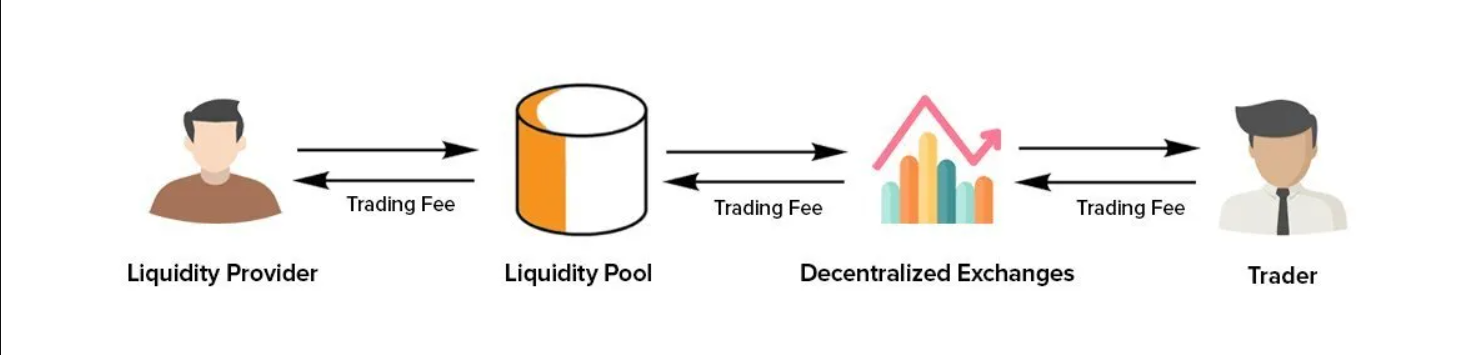
The practice that the friend was pointing to — liquidity mining — falls somewhere in the middle of that list. The concept is quite elegant when you look at it. Traditional exchanges carry out the matching of buyers and sellers by means of an order book: my bid is paired with your ask, and a middleman charges a fee for arranging the deal. That system depends on an exchange which has staff, servers, and a licence. A liquidity pool replaces all of that with just two pots of tokens and one arithmetic rule. Rather than matching orders, the pool simply holds, for example, a large amount of USDT and a large amount of some other token, and anyone who wishes to exchange one for the other does so directly against the pots. The price is adjusted automatically with each transaction, according to a formula as old as secondary school algebra: the two pots must always maintain a constant ratio of value. If you buy a lot of the token using USDT, then the token becomes more expensive within the pool; if you sell a lot of it, then it becomes cheaper. There is no order book, no matching engine, and no middleman — with the important exception of the pool itself.
But here's the catch that makes all the rest of it possible: the pools have to be large. A trading platform with only two hundred dollars of depth will be completely wiped out by anyone who is dealing with real money, since the price would jump around with each transaction. Therefore, the protocols have to get strangers to voluntarily lock up their savings — billions of dollars' worth — and they need to provide a reason for those strangers to do so. The reason is that the pool charges each trader a fee, which is a small percentage of each swap, and then divides that fee among all the people who had put money into the pools. That is the whole basis of the liquidity provision business model: you are not mining anything; you are operating a toll booth on a river of other people's trades. When protocols want to attract liquidity faster than the fees alone can achieve, they introduce a second payment — a bonus in the form of freshly created tokens — and that bonus scheme is what has been labelled liquidity mining. The metaphor stuck because it sounded pleasant to everyone. The term 'miners' suggested that they were hardworking. In fact, the new miners merely have shovels made of arithmetic.
Regular Guy
Let us then look at our first of the three protagonists — let us call him Dennis — who is just what his name suggests: a man with a salary, a small crypto portfolio, and a habit of watching YouTube. Dennis hears that a stablecoin pair on a decentralised exchange offers a return of ten or twenty percent a year simply for not doing anything. The idea, as presented to him in a video which includes a chart and is delivered by a confident speaker, is that he will take the place of the gambler and become the casino; every transaction between USDT and the chain's native token brings a fee, and that fee is his.
Dennis puts into the pool an amount equivalent to two thousand dollars, splitting it equally between USDT and the volatile token since the pool requires the two assets to be of equal value. As a result, he receives a receipt in the form of a token which represents his share of the pools, and from that point on he becomes a landlord. Swaps continue to pass through his property day and night, the fee counter gradually advances. In the first few weeks it is precisely as the videos had promised: passive income, visible to the fourth decimal place, arrives while he is sleeping. Psychologically, this is the feature that no traditional investment has ever been able to offer: he can watch the money working. Banks pay interest invisibly, on a quarterly basis, in an abstract way. The pool, on the other hand, pays out publicly, continuously, with a figure that he can check at two in the morning.

Dennis then finds out — typically in an expensive manner — about the counterweight. When he makes a deposit, the pool compels him to hold half of the volatile token. Should the price of that token rise, the pool's formula automatically sells half of it in order to keep the pots in balance, which means that he has been forced to sell into the rally without having been asked. If the price drops, the pool buys the falling asset all the way down. In either situation, when he comes to withdraw his funds, Dennis usually ends up with less than he would have if he had just held the two assets and done nothing. The income from the fees has to overcome this kind of drag, and this phenomenon is known as impermanent loss — a name so devoid of emotion that it should be considered a marketing achievement, since the loss is in fact permanent in all the cases that matter. As a result, Dennis's actual earnings from the pool are the fees minus the cost of the forced trading carried out by the formula. In some cases this difference is positive; in other cases he may spend a whole year acting as the house only to find that the house was in fact losing money to the players.
Man With the Wrong Machines
The second of the protagonists has genuinely odd equipment and the way he got into pooling is the most unusual of the three. Let us call him Aaron. Up to quite recently Aaron had operated a small mining farm — quite a number of machines working in a converted garage, solving the hash puzzles that were typical of old-fashioned mining. But the economic situation then collapsed for him: the difficulty increased, the rewards were halved on schedule, and one day the machines started earning less than the electricity needed to keep them running. He therefore owned several hundred thousand dollars' worth of equipment which had been specially built for a job that had now ceased to exist.
What he found was that the machines had never actually been his real asset; rather, it was the operational knowledge of a person who had spent years in continuous hardware operation — knowledge relating to maintaining uptime, monitoring costs, carrying out failure analysis, and the tough kind of competence typical of a datacentre operator. This kind of competence proved to be more valuable in the new economy than any particular piece of equipment. Aaron therefore got rid of the machines and purchased servers, then directed them towards markets rather than puzzles. There is a whole professional class among those around liquidity pools who are like him — instead of being landlords they are shopkeepers, running automated programs that keep an eye on pool prices at a number of different venues and make a profit from the small differences, measured in fractions of a percent, when the prices diverge. Whenever Dennis's pool moves out of line with the price on a major exchange, a bot similar to Aaron's immediately buys on one side and sells on the other, thus correcting the pool and earning a guaranteed margin. His income is literally the amount obtained by keeping the pools honest.

It is here too that the vocabulary used for automation proves its value. Working at this level is not a matter of clicking buttons; it is about code communicating directly with blockchains — a connection via the TRON API carrying out strategies at machine speed, TRON automation that rebalances positions and collects rewards according to schedules that no human would ever want to monitor. Aaron, who used to be a hash farmer, immediately recognizes the nature of the work. Although the machines have changed and electricity has become fees and transaction costs, the business is still the same one he has always run: take control of the infrastructure layer, sell uptime, and let everybody else trade on top of you. Instead of minting the money in the past, he now charges people money in order to allow them to move it.
A practical note helps to give substance to his approach. On TRON, where a large portion of the stablecoin activity takes place, each of those automated tasks — each rebalancing and each reward harvest — uses up the network's Energy and Bandwidth, and when the scale of this usage is taken into account, the cost becomes an item that determines whether or not a strategy survives. That is the reason why serious operators handle resource management in the same way as they would fuel contracts: by carrying out bulk delegation, making scheduled top-ups, and negotiating rates. The basic conditions of earlier mining — access to cheap power in large amounts — have almost remained unchanged in the new form of mining.
The Architect
There is also the third person, someone whom both Dennis and Aaron rely on even though neither of them has ever met; refer to him as the architect, that is, the founder of the protocol, the group which deployed the smart contract of the pool and wrote the formula. He is the one who makes this income possible, and to understand him is to grasp the unpleasant origin of all the yield from the liquidity pool.
The true explanation of where the money comes from consists of three elements. The first is actual revenue: the trading fees, which are paid by individuals who exchange tokens, just as a highway is financed by tolls. The second is subsidies: when a new protocol needs liquidity prior to having won people's trust, it produces its own tokens and gives them to depositors — a marketing budget disguised as mining rewards, the money for this being eventually provided by those who later buy the tokens. The third, and one that is least easy to accept, is that, over a sufficiently long period of time in the face of bad behaviour, the return from some pools is simply the money deposited by new users being presented as a return. The system's design is unable to tell the difference. The formula simply distributes whatever money comes in, in a completely neutral manner with no judgment.
The architect's incentives warrant their own paragraph since they are not in any way aligned with those of the depositors. He gains as the protocol expands: with more pools, more volume, and more tokens in circulation. He does not benefit when Dennis's position is profitable and suffers no loss if it is not. It is the liquidity provider who bears the market risk; the protocol itself does not. This is not a scam — it is just the way the system is set up — but it accounts for a consistent pattern: protocols offer ever-increasing emissions in order to draw in ever-greater amounts of liquidity, depositors follow the headline APY, and this whole process goes on until the subsidies run out, when the yield disappears suddenly and the final depositors realize that they were the product all along. The architects who survive are those who regard emissions as a temporary means of getting off the ground and who consider fees to be the real source of income; the ones who don't are, in effect, running advertisements financed by their own shareholders.

It is worth taking a moment to consider how unusual this setup is when compared to all the financial structures that had come before it. In the old system, the person who supplied capital to a market — for example, by putting money in a bank or opening a brokerage margin account — was dealing with an institution that had obligations, underwent audits, and was held responsible when things went wrong. Now, the institution has been replaced by a formula, the obligations by code, and the responsibility by a forum. Nevertheless, the system continues to operate at volumes that are far greater than those of mid-sized national stock exchanges, and the reason for its running is the large number of ordinary depositors: schoolteachers in Lisbon, students in Jakarta, and Dennis with his two thousand dollars. Without realizing it, they carry out the function which market makers had performed for a whole century — being ready to trade with anyone at any time and taking on the risk of inventory — and they do so for a share of fees that institutions would find ridiculous, since the alternative would have been to earn nothing. The pools did not create a new type of investor; instead, they realized that a huge number of people were already investors in all respects except for name, and thus gave them access.
How important are passive investors in this situation? More so than they think they are. They do not simply earn a return; they form the infrastructure — acting as the market-makers of the market, providing the depth that underlies every decentralised trade, and ensuring that a swap on a Sunday morning in a country without banking hours still manages to fill at a reasonable price. All the serious participants in the system, whether they are Aaron's bots or the architects' protocols, rely on the capital that has been accumulated by people such as Dennis. The relationship is symbiotic until it ceases to be, and the dividing line between the two states is defined by risk.
Hole in the Floor
Since the risks are genuine and the industry has always presented them as being in the fine print, begin with those that have already occurred: impermanent loss slowly consuming the fee income of anyone who has deposited funds into a volatile currency pair. Then move on to the others. The smart contracts are based on code that holds large amounts of money, and code is prone to bugs — billions of dollars have already been siphoned from pools as a result of exploits that involved nothing more than a logical error which someone had failed to detect. Rug pulls involve pools that were designed from the very beginning to fail, with the architect not being the founder but a fugitive, and the only purpose of the token being to become unsellable at the predetermined time. Oracle manipulations allow attackers to deceive the formula regarding prices. Stablecoins lose their value. Regulators show up. Each of these risks has its own structure, its own victims, and its own graveyard of threads in which people tell the internet how their savings have turned into exit liquidity.

No matter what else is said, the incentive is truly appealing — and that is exactly the issue. Fees charged on the major currency pairs have actually delivered strong, long-term, double-digit returns for those who have been patient. The system works. In some cases, the infrastructure is now more than ten years old and has been thoroughly tested and scrutinized. The psychological effect acts in a single direction: as soon as you connect your wallet, the annual percentage yield is shown to you in large, easy-to-read figures, while the risks are given in lengthy paragraphs written in legal English and are deliberately hidden. Dennis is never shown the impermanent loss simulator before he puts in his money; instead, the interface displays the yield. The rest is due to loss aversion, survivorship bias, and the ordinary human failure to assign a value to rare events. The pool has no need to mislead anyone; it only has to allow optimism to carry out the calculations.
There is also a more subtle explanation as to why the risks remain underpriced, and this has nothing to do with the kind of people who are celebrated within the ecosystem. The stories that get around are those of the winners — for example, the early provider who turned an ordinary amount into a sum that changed his life, or the farmer who came across an airdrop worth a car. Stories about losses are terrible content. In most cases a person who has had his deposit stolen by a rug pull has no audience and no desire to publicly go over the mistake again, so the collection of visible outcomes consists of a carefully selected gallery of survivors. Newcomers end up with the survivors' version of the map of the territory, a map in which all the swamps have been removed. As for the pool, the protocol, and the architect — none of them gains anything from having the map corrected. When the map is eventually corrected, it is done personally, at a high cost, and always too late to be of any use to anyone except the individual who paid for the correction.
The final view adopted by the majority of those who remain is one of a certain kind of realistic acceptance. Consider pools to be a means rather than a set of principles: stick with deep and dull pairs; realize that headline yield is only a rough figure and it is your actual yield after allowing for drag that counts; assume that every contract might fail and base your position on that possibility; and keep in mind that in a market in which everyone is selling you a strategy, the person who gives a detailed account of the risks is generally the one who is not trying to fleece you.
It's worthwhile concluding with this note on unglamorous competence, since it's the kind of thing that real professionals deal with. When someone is managing large amounts of money through pools, they soon discover that it is rarely the strategy which determines the result — it's the operations. On TRON this involves the dull but essential task of managing Energy and Bandwidth: keeping an eye on balances, scheduling delegations, and making sure that automated strategies are kept running so that a rebalance doesn't fail partway through due to a lack of resources.

It is precisely this operational aspect that the Netts Workspace was designed to streamline — offering a professional dashboard which, in Smart Mode, automatically delegates Energy each time a balance trigger or a schedule calls for it, in Host Mode keeps addresses that are heavily used charged continuously in 24-hour cycles, the AML Check tool checks any counterparty address through Elliptic before you engage with it, and a TRON API using IP-whitelisted keys allows your own automation to connect to all these features — including orders up to 3 million Energy, cost tracking, and reports. The pools will continue to promise amazing things; the Workspace is all about the more modest promise that everything just keeps running. Just as it did in the previous economy, it is the people who are quietly looking after the infrastructure who tend to outlast all those who are chasing yield.